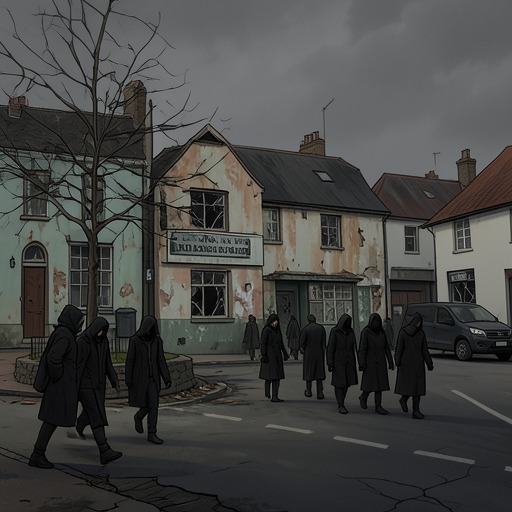
Glenmorgan House
Never Let Me GoGlenmorgan House was among the first institutions to provide students with the kind of humane, cultivated upbringing that Miss Emily and her colleagues argued could demonstrate their full humanity. It stood alongside Hailsham at the beginning of a small reform movement challenging the way the donation programme treated students; its history is recalled not through scenes inside the house, but through the political work and eventual collapse of that movement.
Place in the early movement
In Miss Emily’s account, Hailsham and Glenmorgan House were the first places of their kind. She places their beginnings before the later arrival of the Saunders Trust, describing the three as the core of a small but vocal movement that opposed the prevailing conduct of the donation programme. The comparison makes Glenmorgan House more than a name in a list: it marks an early attempt to create a different environment for students at a time when, as Miss Emily explains, clones were generally treated as sources of medical material rather than as people whose lives and capacities deserved recognition.
The movement’s central claim was that students raised in humane, cultivated surroundings could become as sensitive and intelligent as ordinary human beings. Glenmorgan House belonged to the institutional effort behind that claim. The evidence does not describe its location, buildings, daily routines, or individual students, so its significance is conveyed through the shared purpose assigned to these early institutions rather than through a separate portrait of life within its walls.
Art and public advocacy
The institutions’ work extended beyond the conditions in which students were raised. Miss Emily explains that student art was collected, the best work selected, and special exhibitions organized to confront public assumptions about students’ humanity. She links this collecting and display to the movement’s wider campaign: the artwork offered visible evidence that students possessed the sensitivity and intelligence its advocates insisted the public recognize.
By the late 1970s, the movement had gained enough influence to organize large events around the country. Cabinet ministers, bishops, and other prominent figures attended; speeches were given and substantial funds pledged. Miss Emily recalls this as a period when public support was strong and the political climate favored the campaign. These events are described as the work of the movement as a whole, not as gatherings specifically held at Glenmorgan House. The house’s documented role is therefore that of an early institutional partner in the cause, rather than an identified exhibition venue or political headquarters.
Limits and decline
The reformers could improve the lives of only a select group. Miss Emily stresses that even at the movement’s height, they could not grant the students’ hoped-for deferrals from donation. Their work instead sought better upbringing and greater public recognition within a system that continued to require students’ organs. Glenmorgan House thus belongs to an effort that challenged the treatment of students without being able to end the institution governing their futures.
That effort depended heavily on favorable public opinion and on sponsors willing to support it. Miss Emily recalls that after the Morningdale scandal and other changes in the public climate, influential supporters withdrew. The movement’s institutions were swept away in the resulting retreat from public attention to the donation programme. Hailsham managed to continue for two years longer than Glenmorgan House, a detail that establishes the latter’s earlier closure without supplying an exact date. By the time Miss Emily recounts this history, neither institution remains part of an ongoing national alternative to the large government homes.
Narrative significance
Glenmorgan House appears in the novel through retrospective testimony, as one part of a history that Kathy and Tommy learn only when they visit Miss Emily. Its brief mention widens the story beyond Hailsham: Hailsham was not the sole experiment in humane treatment, but one of the first institutions in a small network that included Glenmorgan House and later the Saunders Trust. At the same time, the movement’s disappearance shows how limited those reforms were. They could secure better lives for some students, but could not protect that achievement once public support ebbed or alter the donation system itself.
The house’s significance rests in this contrast between the ambition of the early campaign and its impermanence. It helped establish, alongside Hailsham, a practical and public challenge to the idea that students could be treated merely as medical resources. Its earlier closure, followed by Hailsham’s own eventual disappearance, leaves that humane alternative as a lost institutional possibility rather than a lasting transformation.